Lingopie: Language Learning
- 4.4
- Rating
- 500.00K
- Installs
- Free
- Price

 Analysis by App-foxy
I approached Lingopie as an education app for people who want language practice to feel closer to normal entertainment than to a traditional lesson. Its central idea is easy to understand: use videos and songs as the material for learning, then turn passive watching into a more active encounter with another language. In my experience, that makes it especially interesting for learners who lose motivation when every session looks like a worksheet.
The app is developed by Lingopie and is available as a free download, with optional in-app purchases ranging from $1.00 to $83.99 per item. It is aimed at users aged Everyone 10+, and its Android listing shows a 4.4 average from around 6.6 thousand ratings, with over 500 thousand installs. Those figures suggest a healthy audience, but they do not replace the more important question: does watching content actually help you build a repeatable study habit?
How Lingopie feels in everyday use
The strongest part of the experience is the change in context. Instead of opening a lesson that announces itself as study time, I can begin with a show or song and pay attention to how words sound inside a real scene. That matters because isolated vocabulary often feels tidy but artificial. Dialogue brings speed, emotion, interruptions, and the small connecting words that learners frequently miss in textbooks.
You May Also Like

 Blood Strike: 2.5 Anniversary
Blood Strike’s Loadouts Turn Every Drop Into a Tactical Gamble
A close look at Blood Strike’s custom loadouts: how fast access to signature weapons reshapes its battle royale rhythm, rewards preparation, and narrows the gap between fights.

 Pandora - Music & Podcasts
Pandora’s Music Is Easy to Start, but Harder to Recover
Pandora’s strength is its low-effort path from a seed to a station. Its weak spot is how much confidence it asks you to place in connection, setup, and quiet recovery.

 8 Ball Pool
 Is Built on Rivalries, Rematches, and Routine
A close look at the rivalries, rematches, shared routines, and unanswered safety questions that turn a quick pool match into a persistent mobile community.

 Samsung Music
’s Quiet Strength Is Playing What You Already Own
Its reach comes less from spectacle than from dependable access to a personal library. That simplicity is both the app’s strongest retention engine and its ceiling.

 AccuWeather: Weather Radar
AccuWeather Review: A Quick, Clear Forecast for Everyday Decisions
For everyday plans, the best forecast is the one you can understand quickly. AccuWeather makes rain timing, radar, and local conditions easy to act on, with a few trade-offs.

 Hill Climb Racing
Why Hill Climb Racing Still Turns Crashes Into One More Run
A tiny car, a bumpy hill and one more upgrade: Hill Climb Racing keeps resurfacing because its simple chaos makes every near-miss feel personal.
More From Our News Desk



I find this approach most useful when I treat the app as guided exposure rather than a complete course. A short viewing session can help me notice pronunciation, recurring expressions, and the difference between a phrase that is technically correct and one that sounds natural. It is less like replacing every other learning method and more like adding a layer of listening practice that is easier to return to.
A realistic routine would be a commuter using a few minutes before work to replay a short section, then returning to the same material in the evening. On the first pass, the goal could simply be understanding the situation. On the second, the learner can listen for familiar words and pause when a useful expression appears. This repeated contact is more productive than constantly jumping from one unrelated clip to another.
The key is active watching, not leaving a video running in the background. If I watch without pausing, repeating, or checking meaning, I may enjoy the content while retaining very little. The app creates a better opportunity for learning, but I still have to decide how deliberately to use it.
Why video and songs can work better than isolated drills
Video gives vocabulary a memory hook. A word connected to a character, a reaction, or a recognizable situation is easier to recall than a word encountered in a bare list. Songs add another kind of repetition: rhythm and melody can make sounds stick, although singing can also blur pronunciation and make lyrics harder to follow for beginners.
I would not use songs as my only listening material. They are useful for hearing repeated phrases and enjoying the target language, but spoken scenes are usually better for everyday conversation. A sensible balance is to use songs when motivation is low and dialogue when the goal is practical comprehension.
Another advantage is emotional variety. A learner can choose something light when tired rather than forcing a dense lesson. That flexibility is not a minor detail. Many language apps are excellent for starting a habit but poor at keeping it interesting after the first burst of enthusiasm. Lingopie’s entertainment-led format has a better chance of bringing a reluctant learner back.
A practical workflow for getting more from each session
I recommend a three-pass method. First, watch a manageable section for overall meaning without trying to translate every sentence. Second, revisit it while paying attention to unfamiliar expressions and the way they are pronounced. Third, speak a few lines aloud or summarize the scene in the language you are learning. This turns one viewing into listening, vocabulary recognition, and output practice.
For beginners, the first pass may need to be very short. Trying to process an entire episode can become exhausting, especially when every sentence contains unknown words. Intermediate learners can stretch the section and focus on speed, informal phrasing, or reduced sounds. Advanced learners may get more value from resisting the urge to translate and using the material to refine natural rhythm.
A useful habit is to save only expressions you can imagine using. If I collect every unfamiliar word, my notes become a second source of clutter. If I choose phrases connected to ordering food, making plans, apologizing, or reacting to news, the review session has a clear purpose. This is one of the less obvious trade-offs of entertainment-based learning: the content supplies context, but I must still filter it for relevance.
I also prefer replaying a difficult exchange before looking for a translation. That brief struggle trains the ear. Checking meaning too quickly can create the illusion that I understood the audio when I really understood the written support. The app is most valuable when I use its assistance to confirm listening rather than to avoid listening.
What the current product says about its development
Lingopie was released on February 22, 2021, and the current Android version is 9.8.56. The version information gives existing users a useful point of reference: this is not a newly launched experiment, but a product that has had time to develop through multiple updates. I would still judge each update by practical stability and ease of use rather than assuming a newer version automatically means a better learning experience.
For someone installing it today, the minimum Android requirement is Android 9. That is reasonably approachable for many devices, although people using older phones should check compatibility before planning their study routine around it. The app’s age rating of Everyone 10+ also makes its general positioning clear: it is designed for a broad audience, including younger learners, while still being a language-learning tool rather than a children’s-only product.
The evolution is most meaningful in how the service has matured around its core concept. The basic promise remains video-led language exposure, so users who already liked learning through shows should find the current version familiar in spirit. Existing users are unlikely to need a completely different study philosophy after an update; the important question is whether the current build makes browsing, watching, and returning to useful material feel smooth enough to sustain a habit.
I would be cautious about treating version numbers as proof of specific improvements. A version change can reflect maintenance, compatibility work, interface adjustments, or feature refinement, but the number alone does not tell me which part of learning has improved. What I can say with confidence is that the app’s present identity is still built around combining entertainment with language practice, not around replacing every conventional study method.
What this means for people who already use it
Long-term users should think of updates in terms of workflow. If the current version opens reliably, plays content comfortably, and lets them return to their learning routine without unnecessary friction, the main benefit is continuity. A familiar setup is valuable because language progress depends heavily on repetition over time.
New users, meanwhile, should not expect the installation itself to create fluency. The app can make listening more approachable, but it cannot decide which phrases matter for a learner’s job, exam, travel plans, or family conversations. I would pair it with a small personal review system, even if that means writing down only five useful expressions after a session.
The free price makes trying the app less intimidating, but the presence of in-app purchases means users should pay attention to what their chosen experience includes before committing to a longer routine. I would begin with a clear test: can I use the available experience consistently for several sessions, and does the format suit my level? That is a better decision than paying simply because the idea sounds appealing.
Where the app fits beside familiar alternatives
Compared with flashcard apps, Lingopie is stronger at listening in context and weaker at delivering tightly controlled vocabulary review. Flashcards are efficient when I need to memorize a specific set of words, but they can leave me recognizing a term on a screen without understanding it in fast speech. Lingopie addresses that gap, though I may still need flashcards or written notes to make new vocabulary stick.
Compared with grammar-focused courses, it is more inviting and less rigid. I can encounter natural phrasing without first completing a sequence of exercises. The trade-off is structure: if I want a carefully staged path from one grammar point to the next, a conventional course may be easier to follow. I would choose Lingopie for exposure and motivation, then use a structured resource when I need a precise explanation of why a sentence works.
Compared with ordinary streaming, the educational angle gives me a reason to pause and study rather than simply consume. That difference is important, but it also creates a higher expectation. If I only want to relax, learning interruptions may feel inconvenient. If I want to learn, ordinary streaming usually leaves me responsible for finding explanations and organizing practice myself.
This makes the app a particularly good match for learners who already enjoy television or music and need a bridge between entertainment and study. It is less suitable for someone who wants a strict daily curriculum, detailed assessment, or a single tool covering pronunciation, writing, grammar, and conversation equally deeply.
Limitations I would consider before relying on it
The biggest limitation is that comprehension can be uneven. A learner may understand a scene because of visual clues while missing much of the spoken language. That is not a failure of the app, but it means I need to test myself by listening again without leaning completely on context or written help.
Content difficulty can also vary sharply. A beginner may find a casual conversation manageable one moment and be overwhelmed by speed, slang, or background noise the next. I would not interpret that frustration as evidence that I am incapable of learning the language. It is a sign to shorten the segment, repeat it, and choose material with a more forgiving pace.
Another limitation is the temptation to browse instead of study. An entertainment library can make choosing the next item feel productive even when I am avoiding difficult review. I solve this by selecting the material before starting and setting one small objective, such as recognizing three expressions or repeating one exchange accurately.
The app also should not be my only source of speaking practice. Watching can improve recognition and listening confidence, but it does not automatically make spontaneous conversation easy. If my goal is to speak with colleagues or travel comfortably, I need opportunities to produce language aloud with feedback from another method or person.
Who should try it, and who should look elsewhere
I would recommend Lingopie to a learner who has started and stopped other apps because formal exercises become repetitive. It is also a good choice for someone who learns well through sound, story, and repetition, or for an intermediate learner who knows many written words but struggles when native speakers talk at normal speed.
It can work for families too, provided each person chooses material appropriate to their ability and interests. The age rating makes it broadly accessible, but suitability still depends on the specific content a learner selects. Younger users may need an adult to help turn watching into a sensible routine rather than unrestricted screen time.
I would skip it as a primary tool if I need exam preparation with a fixed syllabus, highly measurable progression, or intensive writing correction. I would also look elsewhere if I dislike learning through entertainment and prefer short, direct exercises with no narrative distractions. In those cases, a structured course or a focused vocabulary tool will probably deliver clearer progress per session.
What I would watch as the product continues
For future development, I would pay attention to whether the app keeps its entertainment strength while giving learners better ways to organize what they discover. The most valuable improvements would be those that help users return to difficult phrases, maintain a realistic review rhythm, and connect listening with speaking or writing without making the experience feel like a traditional classroom.
I would also watch how well the current version serves different levels. Beginners need manageable entry points, while advanced learners need material that remains challenging after familiar expressions become easy. A broad catalog is useful only when learners can quickly find content that matches their ability and goals.
My final view is positive but specific. Lingopie is not a magic shortcut to fluency, and I would not replace grammar study or real conversation with it. What it does well is make repeated listening feel less like homework. When I use short sections, replay difficult lines, choose practical expressions, and combine viewing with active speaking, the app becomes a genuinely useful part of a language routine. If that sounds more motivating than drilling isolated words, it is worth trying; if you need a complete, tightly sequenced course, it is better treated as a companion than as your only option.
FAQs for Lingopie: Language Learning
01What is Lingopie: Language Learning, and how does it work?
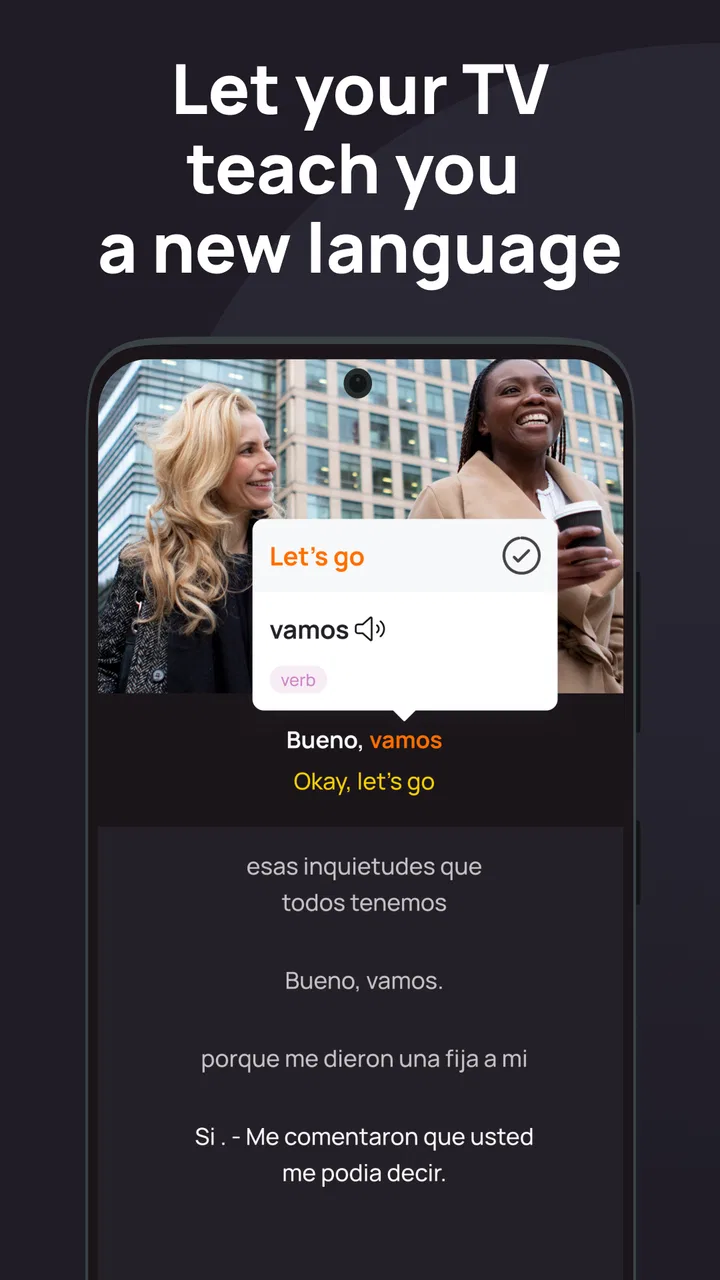
Lingopie is a language-learning app that uses TV shows, movies, and other video content to help you study through real conversations. While watching, you can tap subtitles to view translations and word meanings, save vocabulary, and replay sections when necessary. It is designed to make listening practice more entertaining and practical than traditional flashcard-only learning methods.
02Which languages can I learn with Lingopie?
Lingopie offers courses and video content for several popular languages, including Spanish, French, Italian, German, Portuguese, Korean, Japanese, and other supported options that may vary by platform or subscription. Before downloading, check the current language list in the app store or on Lingopie’s website, since available shows, lessons, and learning tools can differ between languages.
03Is Lingopie suitable for complete beginners?
Yes, beginners can use Lingopie, especially when they choose slower content, translated subtitles, and introductory lessons. However, the app is built around authentic video, so some dialogue may feel difficult at first because native speakers use slang, shortened words, and natural speaking speed. Starting with dual subtitles and gradually removing translations can make the experience more manageable.
04Does Lingopie require a subscription, and is there a free trial?
Lingopie typically provides limited access or trial options before requiring a paid subscription, although the exact offer can change depending on your country, device, and promotion. Carefully review the pricing page before confirming payment, including billing frequency, renewal terms, and cancellation instructions. If you start a trial, remember that it may automatically convert into a paid plan.
05Can I use Lingopie offline or without an internet connection?
Lingopie is primarily designed for streaming video, so a stable internet connection is generally needed for the best experience. Offline availability, if offered for particular content or subscription plans, may be limited and can depend on licensing restrictions. If you plan to study while traveling, check whether downloads are supported in your version of the app before relying on it without mobile data.
Pros
- Binge-watching makes regular language exposure feel entertaining and motivating.
- Subtitles can be switched between languages to support gradual comprehension.
- Useful vocabulary tools help learners review words encountered during shows.
- The app offers content for several popular languages in one subscription.
- Playback controls make it easier to slow down or repeat difficult dialogue.
Cons
- The catalog and available features may vary depending on your region.
- Some shows may have limited subtitle or translation options.
- Advanced learners may find the exercises too basic for their level.
- A stable internet connection is often needed for smooth streaming.
- The subscription cost may feel high for users learning only occasionally.

Lingopie: Language Learning
Gallery